Part II: Why Data Governance Matters More Now!
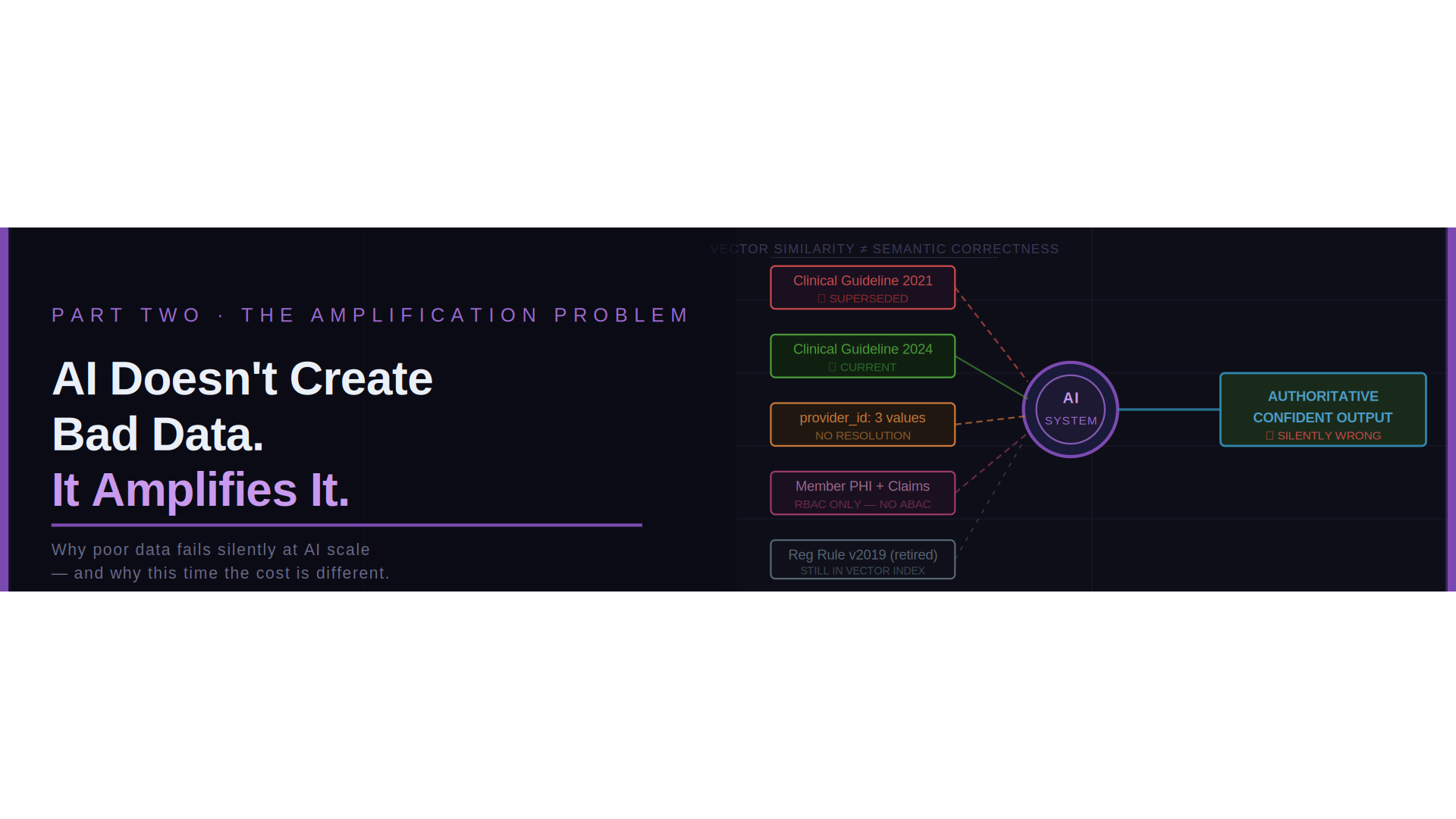
Part I showed how enterprise data debt accumulates quietly through legacy platforms, fragmented semantics, underpowered governance, SaaS transitions, regulatory overlays, and data lakes that expand access faster than context. The risk is no longer limited to poor reporting or delayed analytics. In an AI-agent environment, ambiguous meaning, broken lineage, stale logic, and weak access controls become production risks because agents retrieve, combine, reason, and act across domains at machine speed.
Part II begins there: AI does not create these weaknesses, but it makes them harder to ignore, faster to propagate, and more consequential when they reach the business.
AI Amplifies of Existing Data Problems
Every major transition in enterprise data has exposed weaknesses in the data environment beneath it. Business intelligence exposed inconsistent dimensions. Self-service analytics exposed the absence of governed metric definitions. Machine learning exposed unreliable training data. Generative AI and agentic systems expose all of these issues at once, and at a scale and speed of consumption that is genuinely new.
The amplification mechanism is straight-forward: a language model, retrieval-augmented system, or enterprise agent does not necessarily fail visibly when it encounters poor data. It can fail quietly, producing confident outputs grounded in inconsistent, outdated, incomplete, or incorrectly permissioned information. Those failures are often invisible to users who lack the domain context or source-level access needed to evaluate the answer. A business intelligence report with a data quality issue produces a wrong number that a trained analyst may notice. A GenAI system with the same issue can produce a coherent, authoritative-sounding explanation that is wrong in ways that are much harder to detect.
In healthcare claims management, this failure mode has direct financial, clinical, and regulatory consequences. A prior authorization recommendation grounded in a clinical policy document that was retired six months ago, retrieved from a vector store with no reliable concept of document currency, can produce an answer that appears correct but is not. The cost of acting on that recommendation whether inappropriate approvals, regulatory exposure, appeals, or potential member harm, is operationally concrete and potentially significant.
In financial regulatory audit, the equivalent failure is a synthesized analysis that draws from a knowledge base containing superseded rules alongside current guidance, with no reliable distinction between them. The AI does not know that a rule changed unless the retrieval layer, metadata, or governance process makes that fact explicit. It knows only what appears in its training data or retrieval index. The output may blend old and new requirements, contradict itself, or omit the conflict entirely.
Retrieval Without Semantic Awareness
Retrieval-augmented generation has become a common architecture for enterprise AI because it grounds model responses in enterprise-specific documents and data, reducing dependence on the static knowledge of a base model. It is a sound architectural pattern. Its weakness is that retrieval often optimizes for semantic similarity, not semantic authority, currency, permission-ing, or correctness.
A vector embedding of a document chunk captures surface-level linguistic similarity to a query. It does not, by itself, determine whether the document is current, authoritative, approved for the requester, or consistent with the rest of the corpus. In a healthcare context, a 2021 clinical guideline and its 2024 replacement may have very similar embeddings. A retrieval system without explicit version, status, authority, and effective-date metadata may return both. The language model may synthesize an answer from both. The result can be confidently wrong in a way that is difficult to detect without knowing that both versions exist.
Knowledge graph approaches, often deployed alongside vector stores, address part of this problem by capturing relationships that flat embeddings cannot represent. A graph over provider networks, member relationships, and claims patterns can surface fraud patterns or operational risks that similarity search alone would miss. But a knowledge graph built on ungoverned entities is not reliable knowledge infrastructure. It can become an expensive mechanism for propagating entity-resolution failures at scale, connecting records that should remain separate and separating records that represent the same real-world entity.
Intersections with Access Control and Regulated Data
The combination of AI’s cross-domain consumption and the regulatory sensitivity of enterprise data create a governance challenge that most current access-control architectures were not designed to address. Role-based access control, the dominant model in many enterprise data environments, manages permissions at the dataset, table, application, or role level. It was not designed for a world in which a single AI-agent query might simultaneously touch clinical history, claims records, financial data, and HR information, producing a synthesis whose sensitivity is greater than any individual source.
Attribute-based access control, where permissions are evaluated against the properties of the data, the requester, the purpose, and the operating context, is the architectural direction that scales better for AI consumption in regulated environments. But implementing it requires knowing what the data means: its sensitivity, regulatory category, provenance, business context, and permitted uses. That requires a governed semantic layer. Most organizations do not yet have one. They have system-level permissions, manual data-sharing reviews, and compliance controls that struggle to evaluate sensitivity across combinations of data.
The semantic technologies that provide part of this foundation , OWL ontologies for expressing entity definitions and relationships, and SHACL constraint shapes for machine-executable validation. Both are mature, open, and well supported standards, but neither are widely deployed as operational governance layers in enterprises. The likely culprit? Tooling has favored proprietary catalogs and governance in SaaS and Application products that may implement similar concepts. but in closed, vendor-specific ways in effect “Islands”. The absence of a vendor-neutral, singular, semantic layer is one of the specific technical debts that AI-agent deployment is now making visible.