The Weight [Wait] Of Legacy Data
Enterprise AI Constrained by Data Debt
The promise of enterprise AI is real, but most organizations are not yet ready to operationalize it safely or reliably. Across healthcare claims management, financial regulatory audit, legal document management, and the broader enterprise landscape, organizations are reaching an inflection point while carrying decades of structural data debt: inconsistent semantics, broken lineage, ungoverned databases and data lakes, and governance frameworks that were never designed for the speed, scale, cross-domain access, or contextual precision required by AI agents. This piece examines how that debt accumulated, why it matters more now than in any prior technology transition, and what genuine realignment looks like for organizations serious about building agentic AI capabilities on trusted, contextual foundations that can support the level of confidence an enterprise requires.
How Did We Get Here?
An Accumulation of Poor Processes
Enterprise data environments do not fail in a single moment. They degrade across decades, through a sequence of individually reasonable decisions that collectively produce an architecture nobody would have designed on purpose. Understanding that accumulation is the prerequisite for understanding why AI deployments encounter it so consistently and so late.
The dominant pattern in large organizations is a data warehouse built in layers. An initial investment in the 1990s or early 2000s created a reporting infrastructure that worked well enough for the analytics of its era: batch refresh cycles, fixed dimensional models, a relatively small number of approved data updaters or consumers, and business logic encoded in stored procedures that were authored by people who no longer work at the organization. That foundation was not replaced when requirements grew. It was extended. New source systems were wired in. New ETL jobs were added around the edges. Exceptions accumulated. The dimensional model that described a product hierarchy in 2004 was patched to accommodate an acquisition in 2011, patched again when a new ERP was introduced in 2016, and patched a third time when a SaaS platform brought its own entity model that did not align with either prior version.
What this produces is not one data environment but several, coexisting under the label of a single enterprise data platform. The surface looks coherent. The substrate is not.
The dimensional model that described a product hierarchy in 2004 was patched to accommodate an acquisition in 2011, and patched again when a new ERP arrived in 2016. What this produces is not one data environment but several, coexisting under the label of a single platform.
A Semantics Problem at the Core
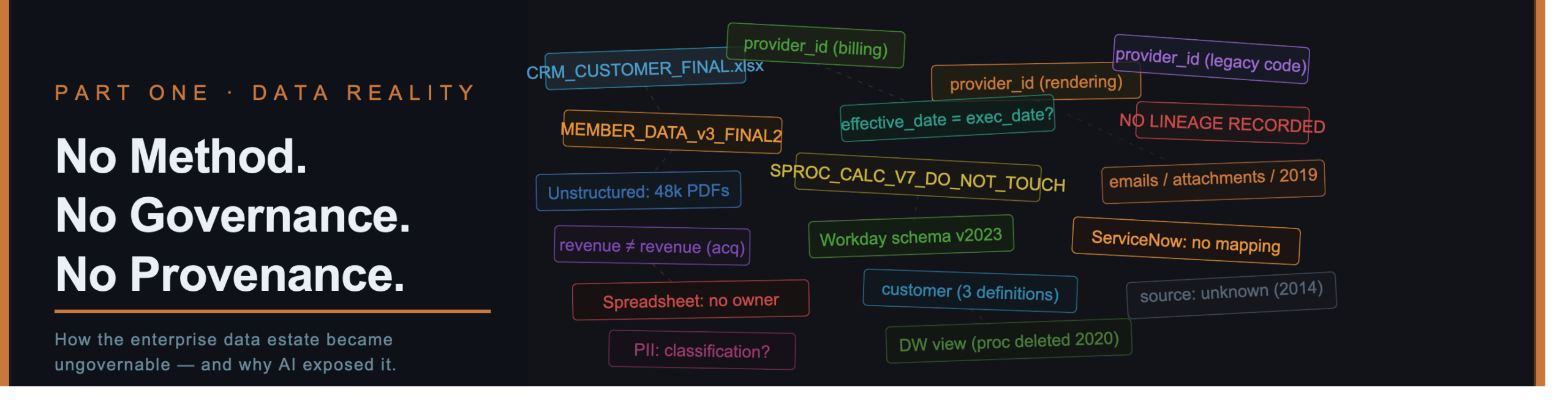
The most consequential form of debt is not technical. It is semantic. In a healthcare payer organisation, the field labelled provider_id may mean the billing NPI in one system, the rendering NPI in a second, and a legacy internal code in a third. Nobody intended this. It happened because each system was implemented by a different team, at a different time, under different delivery pressures, with no mechanism to enforce a shared definition. The data dictionary, if it exists at all, is a document that was last reviewed in 2019 and has no enforcement authority over anything.
In a financial services context, the equivalent is the calculated field that feeds a regulatory submission. Someone built the calculation in a stored procedure that accumulated business exceptions over many years. The original author cannot be found. The logic is not formally documented. The regulatory team relies on it because the numbers have always passed review, but nobody can state with confidence what the procedure actually does in every edge case.
In legal document management, the semantic failure shows up in contract metadata. Effective date and execution date are used interchangeably by different business units but represent genuinely different legal moments with different implications for obligation commencement, termination windows, and notice periods. The contract management system treats them as the same field because the original implementation did not resolve the ambiguity. These are not isolated examples. They are structural features of any data environment that was built over time by multiple teams without a governing semantic authority. And they are the specific features that make AI deployment dangerous, because a language model or a retrieval pipeline has no way to detect semantic ambiguity. It reads the field name, not the conceptual confusion underneath it
The Investment Gap: Talent, Leadership, and Governance That Never Scaled
The organisational response to growing data complexity followed a familiar pattern. Companies hired data engineers to build more pipelines. They invested in analytics tooling. They created data science teams. What most forgot or avoided, and this is the specific gap that is now the challenge, is invest in the governance infrastructure and senior leadership necessary to make that data reliable at scale – lineage, provenance, authorized, and in the context of the processes within the business.
The Chief Data Officer problem
The Chief Data Officer role emerged as a recognition that data needed executive ownership. But the implementation of that recognition has been uneven to the point of being counterproductive in many organisations. CDOs were hired with mandates to drive analytics value and AI capability but without the organisational authority to enforce data standards across business units that had been managing their own data environments for years. The role was often positioned as a function of the technology organization rather than the business, which meant it had no direct influence over the source-system owners who were producing the problematic data.
Where CDOs succeeded, they succeeded by building governance as a business function rather than a technology function: establishing data ownership at the domain level, creating cross-functional data stewardship councils with real authority over definition and quality standards, and connecting data quality outcomes to business metrics that executives cared about. Where they failed, they failed by attempting to impose centralized technical standards on a decentralized business without the political mandate or the operating model to make those standards stick.
Many organizations cycled through multiple CDOs in the 2015-2023 period, each inheriting the failures of their predecessor and leaving behind a partially completed governance framework that the next person would attempt to rebuild from a different starting point. The result is an accumulation of governance artifacts: data dictionaries, data quality frameworks, stewardship models, lineage tools. All these capabilities represent real investment sbut do not form a coherent, operational system or provide the context needed for AI to perform at expectations.
A Talent Issue
The skills required to build and maintain a governed data environment are not the same skills required to build data pipelines or train machine learning models. Data modelling at an enterprise semantic level, ontology design, data quality rule engineering, and master data management are disciplines with their own depth and their own career paths. The market for these skills has been consistently underinvested relative to the demand for data engineers and data scientists.
The consequence is that organisations built large data engineering teams capable of moving data quickly and large analytics teams capable of building models, with a much smaller investment in the people who could make the data those teams were working with trustworthy. That imbalance is now visible in AI project timelines. The engineering capacity to deploy a model exists. The governance capacity to validate that the model is reasoning from reliable, correctly defined data often does not.
Additional Pressures (x Multipliers) – Acquisitions, Regulatory Change, and Modern SaaS
Three external forces have compounded the organic accumulation of data debt in ways that deserve specific attention, because each one represents a governance failure point that is distinct from the gradual entropy of aging systems.
Acquisitions and integration debt
A merger or acquisition is, from a data perspective, a collision of two or more independent semantic universes. Each organization has its own entity definitions, its own master data, its own business logic, and its own set of field-level ambiguities. The integration challenge is not simply technical, it is fundamentally conceptual. What does the combined organization mean by customer? By product? By revenue? These questions do not have obvious answers, and the pressure of post-merger integration timelines works directly against taking the time to resolve them properly.
The common response is to federate the data environments while building point-to-point integrations for the most urgent reporting needs, with an intent to rationalize later. Later rarely arrives. The organization grows accustomed to the federated state, builds analytical workflows on top of it, and the rationalization becomes progressively more expensive as dependencies accumulate. Healthcare organizations that have undergone significant payer consolidation carry this debt in acute form: member records that exist in multiple lineages, provider networks that were never fully reconciled, claims processing rules that reflect the policies of legacy entities rather than the combined organization. Add to this the rapid changes in vocabulary in the shifts thru ICD-9, ICD-10, SNOWMED, HL7 FHIR … brutal reconstitutions of new standards, and the need to combine across models and standards.
Regulatory change velocity
Regulatory environments have not become simpler. HIPAA and its HITECH amendments, CMS price transparency rules, GDPR and its state-level analogues, the evolving landscape of algorithmic transparency requirements, and sector-specific frameworks like DORA in financial services all impose data requirements that organizations must implement while continuing to operate their existing systems. Each new regulatory requirement creates pressure to tag, classify, restrict, or transform data in ways that the existing data environment was not designed to support.
The result is regulatory compliance implemented as a layer on top of an ungoverned data environment: access controls applied at the system level without semantic awareness of what data is actually sensitive, retention policies enforced through scheduled deletion jobs that cannot reliably identify what they are deleting, and audit trails maintained in separate compliance systems that cannot be connected back to the operational data they are supposed to document. This architecture passes audits because it satisfies the letter of the requirement. It does not produce a genuinely governed environment because the governance is implemented as an overlay rather than as a structural property of the data itself.
The regulatory challenge is particularly acute for AI deployment because AI systems consume data across domains simultaneously. A large language model ingesting claims data, clinical notes, member demographics, and prior authorization records is potentially accessing a combination of data that triggers regulatory obligations none of those domains would trigger individually. A compliance framework built on per-system access controls has no mechanism to evaluate or enforce the sensitivity of data combinations.
The SaaS transition and the disappearing logic layer
The shift to modern SaaS platforms: Workday for HR and finance, ServiceNow for operations and ITSM, Salesforce for customer management, and their equivalents across every business functional domain has introduced a specific and underappreciated form of data debt. These platforms have their own data models, their own entity definitions, and their own APIs. They are not designed to conform to an enterprise semantic standard. They are designed to be best-in-class applications that enterprises adopt.
The integration challenge is real but manageable. The deeper problem is what gets lost in the transition. Legacy transactional systems often accumulated years of business logic in their database layer: stored procedures, views, calculated fields, and dimensional hierarchies that encoded genuine institutional knowledge about how the organization defined its core concepts. When those systems are replaced by SaaS platforms, that logic layer typically does not migrate. It is either rebuilt in the new system’s native configuration framework; without reference to the original logic, or it is simply discarded, with the expectation that the SaaS platform’s standard model is close enough.
Neither outcome supports sound data governance. Much of the business knowledge embedded in legacy logic exists only in code. When that logic disappears, the organization loses a significant part of its operational semantic layer: the accumulated understanding of what its data means in business context. AI systems that ingest this data inherit not only the surface-level records, but also the missing context that once gave those records meaning.
When legacy systems are replaced by SaaS platforms, the business logic encoded in stored procedures and dimensional hierarchies often does not migrate. The organization loses a significant portion of its operational semantic layer aka. the data in context(s) [the accumulated understanding of what its data actually means.]
The Data Lake Promise and It’s Governance Deficit
The data lake was proposed as the solution to the rigidity of the warehouse. Rather than forcing all data through a fixed schema at ingestion, the lake would accept data in its native form and defer transformation to query time. This was architecturally honest about the diversity of enterprise data. It was strategically optimistic about the governance discipline required to make deferred transformation reliable at scale.
The democratization promises of the data lake — that business users could access raw data directly without the bottleneck of central IT — was realized in some organizations. In many others it produced a different problem: data consumers working directly from source data without the transformations, validations, and semantic enrichments that the warehouse layer had previously provided. The quality controls that were implemented in ETL pipelines were not replicated in the lake. The dimensional context that gave warehouse data its analytical meaning was not carried into lake storage. The result was faster access to less reliable data, consumed by more people with less context for evaluating its quality.
The transition also moved business logic further from centralized control. In a warehouse architecture, the transformation logic that produced analytical dimensions was maintained by a central data engineering team with some visibility and accountability. In a lake architecture, that logic proliferated into individual notebooks, departmental pipelines, and ad hoc transformation scripts maintained by analysts who had no formal responsibility for data quality. When AI systems ingested from these environments, they inherited the fragmentation.