

The Trust Tax
Every cross-border equipment lease, every research grant milestone, every multi-party supply chain settlement shares the same bottleneck: trust costs money. Businesses lose billions annually to what we call the trust tax; the friction, delays, and exorbitant fees that come from relying on manual escrow agents, custody banks, and intermediary lawyers to sit between counterparties and say, “Yes, you can release the funds now.”
The underlying question is deceptively simple: How do you guarantee payment without surrendering control or liquidity to an inefficient third party?
This prototype answers that question. Built on the Canton Network and written in Daml, our Stablecoin Escrow Platform transforms trust from a variable human process into a cryptographic certainty. Settlement isn’t merely automated, it is authoritatively synchronized across all parties on the ledger.
How the Escrow Lifecycle Actually Works

Traditional escrow is a phone-call-and-PDF affair: draft the terms, wire the funds to a holding account, wait for manual confirmation, argue about conditions, and eventually receive a disbursement many days or weeks later. Every step requires human judgment, and every handoff introduces delay and risk.
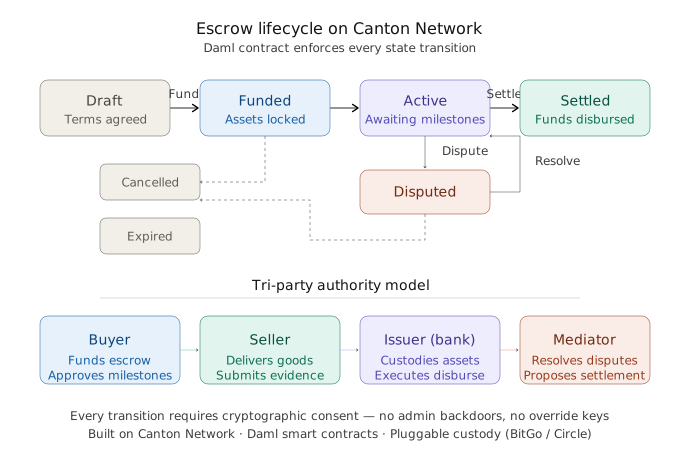
Our platform encodes this entire lifecycle into a Daml smart contract that enforces each transition with mathematical precision. Here is the sequence:
DRAFT → FUNDED → ACTIVE → SETTLED (or EXPIRED | CANCELLED)
In the Draft phase, the Buyer, Seller, and Issuer (the custodial bank) cryptographically agree on terms: the escrowed amount, the currency, the milestone conditions, the expiry date, and the dispute window. No party can unilaterally alter terms after mutual signing.
Once the Buyer exercises the Fund choice, stablecoins are locked on-ledger. The contract moves to Funded and becomes enforceable. This is not a “promise to hold”, the assets are cryptographically locked within the ledger itself, visible to all signatories, movable by none until the contract authorizes it.
In the Active state, the system waits for conditions to be met. When a milestone is satisfied, the Buyer (or an authorized oracle acting as Buyer) exercises ApproveMilestone, which triggers the creation of an EscrowSettlement contract, signaling the Issuer to release stablecoins proportionally. If conditions aren’t met, either party can RaiseDispute, freezing further milestones until a designated Mediator proposes a resolution that both parties ratify.
The contract reaches a terminal state when Settled, Expired, or Cancelled, and the ledger records the outcome immutably. No ambiguity. No post-hoc reinterpretation of terms. The code is the agreement.
Deep Dive: Regulatory Compliance & Tri-Party Mechanics
From a financial and regulatory standpoint, the unique challenge of digital asset escrow is maintaining a clear audit trail while ensuring that “locking” funds doesn’t violate custody standards or create double-spending vulnerabilities.
The Tripartite Authority Model
Unlike simple smart contracts that rely on vulnerable external oracles, this platform enforces a Tri-Party Authority Model where every state transition is governed by explicit, role-based authorization:
The Buyer and Seller are co-signatories on contract creation and settlement ratification. Neither party can settle or cancel without the other’s cryptographic consent. The Issuer (a bank or qualified custodian) is a signatory on all states it holds the asset and must authorize any release. A Mediator has narrowly scoped authority: it can only act when a dispute has been raised, and even then, its proposed settlement must be ratified by both Buyer and Seller before the Issuer disburses.
This is consent-driven settlement. The Daml runtime enforces these authorization rules at the language level a party literally cannot exercise a choice it is not authorized to control. There are no admin backdoors, no override keys roles are never conflated and each has specific view/mutate permissions.
CIP-0056: The Standard for Pluggable Custody & “The Dynamic Stablecoin Factory”
To be truly institutional-grade, an escrow platform cannot be locked into a single custodian. Our architecture introduces a Dynamic Stablecoin Factory, a pluggable interface adhering to the CIP-0056 standard for “Holding” and “Transfer” operations. This allows institutions to switch between custody providers seamlessly:
BitGo integration leverages local signing proxies (BitGo Express) for high-security, hardware-backed vaulting, ideal for institutions that demand cold-storage-grade protection with qualified custody and up to $250M in insurance coverage.
Circle Wallets (WaaS) integration utilizes developer-controlled programmable wallets for rapid, API-driven movement of digital dollars; well suited for operational accounts that need speed and programmatic flexibility.
The pluggable design means a single escrow contract can be backed by either provider without changing the Daml template logic. The custody layer is abstracted; the escrow semantics remain deterministic.
Schema-Driven Extensibility: One Contract, Any Domain
A key architectural decision: domain-specific metadata: serial numbers, parcel IDs, tracking numbers, inspection certificates are not hardcoded into the Daml templates. Instead, the platform uses a schema-driven metadata layer where “Contracted Elements” are attached as structured, validated JSON alongside the core financial lifecycle.
This means the same escrow engine can settle an equipment lease in industrial manufacturing, a milestone payment for a research collaboration, or a multi-tranche delivery in a software supply chain without rewriting or redeploying the core contract. The financial dynamics are the stable layer; the business context is the flexible layer.
Why Canton and Daml?
The choice of infrastructure is deliberate.
The Canton Network is a privacy-enabled public blockchain designed for institutional finance. Unlike public blockchains where every transaction is visible to the world, Canton ensures that sensitive agreement metadata remains private between the counterparties involved. It operates as a “network of networks”, where each institution maintains its own sub-ledger while connecting through a shared synchronization layer. Transactions are atomic. they either complete fully or not at all, and data is distributed only on a need-to-know basis. Canton is backed by a consortium that includes Goldman Sachs, Deutsche Börse, Microsoft, and Deloitte, and is governed by the Canton Foundation under the Linux Foundation.
Daml is the smart contract language that makes this possible. Built on Haskell with strict evaluation, Daml lets you write the rules of a multi-party workflow once specifying exactly who can see what, who can do what, and under what conditions and execute them with deterministic accuracy across distributed nodes. Authorization and privacy aren’t bolted on after the fact; they are first-class primitives in the language itself.
The Tech Stack
This pilot was authored by Dan Hushon, with the help of Gemini and the GCP ecosystem, following an API-forward design:
The backend API services are written in Go 1.25, serving as a hard security boundary aligned with Daml’s role-based authorization model. The frontend is built with Astro/Vite, consuming the API layer cleanly. The entire system runs in a small number of containers designed for enterprise deployment, but supporting developer testing through feature flags.
See the full source on GitHub →
Where This Goes?
This is a prototype, and we are transparent about that. But it proves the thesis: a fully digital escrow system where compliance is encoded in the contract, custody is pluggable, settlement is deterministic, and privacy is structural is not a theoretical exercise. It is buildable today.
More importantly, the scaffolding is reusable. If you are building on Daml and the Canton Network. Whether for trade finance, tokenized securities, data sets, or AI/ML-model licensing, the patterns demonstrated here (tri-party authority, schema-driven metadata, pluggable custody) are directly applicable to your problem space.
The ledger is the source of truth. Compliance is baked into the code. And the trust tax? It is heading toward zero.


