Part III: Re-AI-lignment for Enterprise Data
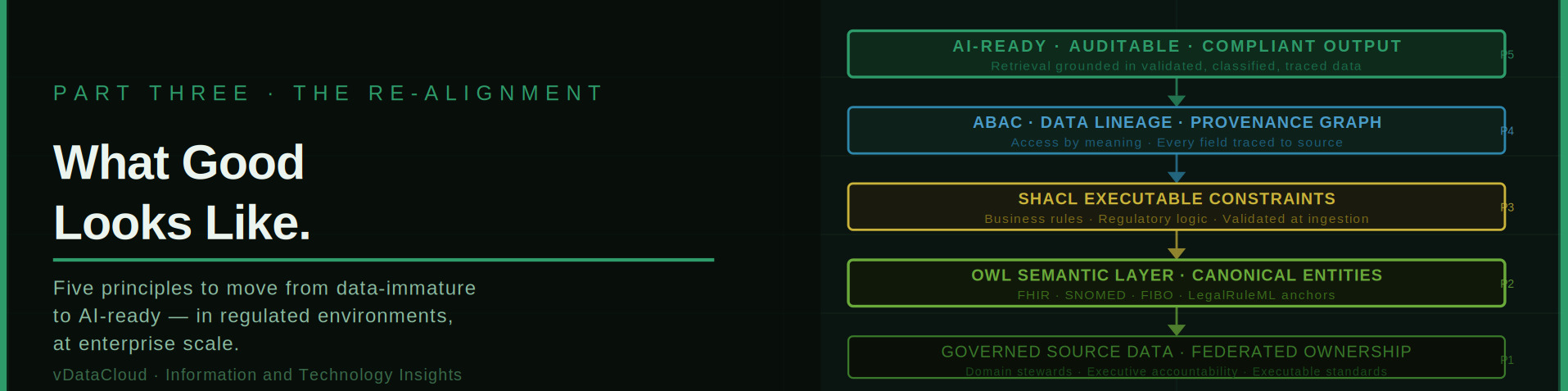
The first two parts showed that enterprise AI readiness is constrained by more than model capability. Legacy platforms, fragmented semantics, weak lineage, SaaS transitions, regulatory overlays, and under-governed data lakes have left many organizations with data that is accessible but not reliably meaningful. AI agents magnify that weakness by retrieving, combining, reasoning, and acting across domains at machine speed. Part III turns from diagnosis to design: what a modern data environment must look like when meaning, constraints, lineage, access control, and accountability are treated as core architecture rather than governance afterthoughts.
The path from data-immature to AI-ready does not need to start with a five-year infrastructure program. It can start with targeted interventions against the failure modes that matter most to the AI use cases in scope. The organizations moving fastest are not those that waited for a complete data transformation. They are building governance incrementally, beginning with the domains, entities, policies, and constraints most critical to production AI.
Principle One: Govern Meaning Before Governing Data
The first shift is from governing data as a technical asset to governing meaning as a business asset. The goal is not only to enforce data types, remove nulls, or document datasets. It is to ensure that the same data means the same thing to the people, systems, and AI agents that use it.
That requires a working semantic layer: canonical entity definitions approved by the business and expressed in a form both humans and machines can use. OWL provides an open foundation for defining enterprise concepts and relationships. In healthcare, this may start with HL7 FHIR and SNOMED, then extend where the organization needs more specificity. In financial services, FIBO provides a useful base. In legal environments, LegalRuleML and contract ontology work offer practical starting points.
A semantic layer does not replace the catalog or data dictionary. It makes them operational. A catalog entry for provider_id that points to a canonical definition of BillingProvider can be used by systems. A note that says “the ID of the provider” cannot.
Principle Two: Make Constraints Executable, Not Documentary
SHACL, layered over an OWL ontology, lets business and regulatory rules run as validation logic. A shape can require every ClaimRecord to have one BillingProvider, require that provider to have a valid NPI in the current CMS registry, and require the ServiceDate to fall within the MemberEligibilityPeriod. These are not standards sitting in a document. They are rules that can run in a pipeline and flag violations before the data reaches downstream users or AI systems.
This is the move from documentary governance to executable governance. Data-quality checks no longer depend on informal knowledge or late-stage review. They run before data enters a model context window, retrieval index, feature store, or decision workflow. The AI reasons from validated data, not raw, ambiguous, or expired inputs.
- Executable constraints catch data quality issues at ingestion or transformation, not after inference.
- Constraints expressed in SHACL can be versioned, audited, tested, and reused across systems.
- The constraint layer gives regulatory and business rules a working form, instead of leaving them as static documentation.
- If AI systems suggest constraint changes, human review becomes the approval workflow, not the starting point for rule discovery.
Principle Three: Build the Access Control Model on the Semantic Layer
Data sensitivity depends on meaning, not where the data resides. A member’s diagnosis code remains sensitive regardless of the system that stores it. Combined with claims history and employer information, it may become even more sensitive, depending on jurisdiction, policy, and purpose of use. Access-control models that cannot interpret the semantic content of data cannot reliably evaluate or enforce these distinctions.
Attribute-based access control, tied to the semantic layer, makes this practical. Access can be evaluated at query time against the data, requester, purpose, and operating context. An AI system supporting clinical decisions should not have the same access as one supporting claims audit, even when both use overlapping data domains.
This requires semantic classification: tagging entity classes and attributes with regulatory categories, sensitivity levels, retention obligations, permitted uses, and policy constraints. The work is not trivial, but it is reusable. Once defined, the same classifications can govern systems, pipelines, retrieval layers, and AI-agent workflows.
Principle Four: Establish Data Lineage as a First-Class Architectural Concern
Every field that influences a compliance decision, payment authorization, or contractual obligation needs traceable lineage from source to use. This is not a new requirement. It is one organizations have often deferred in favor of moving data faster.
Modern lineage tools, including Apache Atlas and major cloud-provider offerings, make this achievable if lineage capture is built into pipelines from the start. The key principle is simple: lineage is a property of data movement, not a separate documentation task. Each transformation, join, aggregation, and enrichment should record its contribution to the output field’s lineage graph.
For AI, lineage does two jobs. It supports auditability: when an AI system produces a recommendation, summary, or decision-support output, the data behind that output can be traced to its source and validation status. It also supports impact analysis: when a source system, policy document, ontology, or transformation changes, the lineage graph shows which AI systems and workflows may be affected.
Principle Five: Align Organizational Structure with Data Accountability
The technical work will not hold unless ownership is clear. Each business domain needs accountability for the quality and meaning of its data. A central governance function should provide standards, tooling, and escalation paths, but the domains must own the data they create and use.
The right model balances accountability with speed: standards without bureaucracy, escalation without over-centralization. A healthcare provider-data steward who owns provider record quality, receives automated constraint violations, and is measured on data quality outcomes is more effective than a central team finding issues in quarterly audits.
At the executive level, the Chief Data Officer needs a mandate that spans technology and business operations, with authority over data standards comparable to the authority other C-suite functions have over financial controls or security standards. Data quality failures that create regulatory exposure, operational loss, or AI risk should be visible as business risks, not only as dashboard metrics.
What the Re-aligned Environment Looks Like for AI
When these principles are in place, the AI system sees a different data environment from the one described in Part I. Field names are backed by canonical definitions. Records carry lineage and validation status. Access decisions account for who is asking, why they are asking, what data is involved, and what policy allows.
The outputs improve because the inputs improve. Retrieval pipelines return content that is current, validated, classified, and permissioned, not merely similar. Knowledge graphs built on governed entities support fraud detection, risk analysis, and pattern recognition with less entity confusion. Constraint layers express business policy and regulatory limits in a form AI systems must operate within.
The AI system’s outputs are more reliable not because the model is better, but because the inputs are trustworthy. This is the re-alignment: not a different AI strategy, but a data foundation worthy of the AI ambition.
This is not a distant ideal. Leading organizations in healthcare, financial services, legal, and other regulated domains are already building it in pieces: domain by domain, use case by use case. The organizations that gain durable advantage from AI will not simply have better models. They will have data foundations that make those models safe, useful, and repeatable in production.
Decades of data debt will not be resolved in one program. But it can be reduced in the right order: define meaning, make constraints executable, capture lineage, enforce access by context, and assign real accountability. That is the re-alignment. For enterprises deploying AI in regulated, high-consequence environments, it is becoming a condition of production readiness.
Next in this series: Consistently Governed Data Fabrics. This will include policy controls for federated enterprise data. Examining how enterprise and industry ontologies, semantic catalogs, and governed data products can support consistent policy enforcement across federated data environments. The discussion will focus on managing roles, project context, permitted use, sensitivity, and purpose-based access so organizations can unlock protected data safely for production AI, without reducing the data fabric to infrastructure alone.